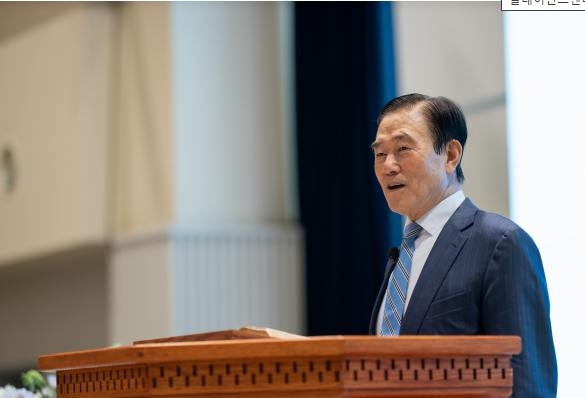
On the night the Berlin Wall fell, people were not merely watching a physical structure collapse. They were also hearing the sound of long-standing fear, familiar prejudice, and an old order that had defined people as strangers to one another begin to crumble. Acts 10 presents just such a scene within Scripture. It is not a visible wall, but the strongest boundary between Jews and Gentiles collapsing before the Holy Spirit. This is precisely what Pastor David Jang, founder of Olivet University, repeatedly emphasizes in this passage. The gospel cannot be confined within fences made by human beings, and God's grace moves far more widely and deeply than the categories we establish.
Acts 10 may appear to be the story of two individuals, but in reality it is a great turning point that reveals how God opens the door to world mission. One man is Cornelius, a Roman centurion; the other is Peter, a disciple of Jesus. They differ in ethnicity, culture, and religious background. From a purely human perspective, they seem like the least likely pair ever to sit together. Yet the Holy Spirit prepared both of them at the same time. This is the mystery of the gospel. Mission always begins not with human planning, but with God's prior preparation.
Cornelius was a soldier, yet at the same time he was a man who feared God and devoted himself to prayer and almsgiving. This scene is profoundly important. God was already preparing a soul in a place many would have considered outside the church. By human religious standards, he may have appeared unfinished, but God's hand was already at work in his life. Through this point, Pastor David Jang reminds us that we must never assume that someone is outside the work of God simply because they are not yet inside the church. God is always at work ahead of our expectations.
Even more striking is Cornelius's obedience. When he received the vision, he did not hesitate. He did not move because he fully understood everything; he moved because he responded to the word he had heard. Here we learn again the essence of faith. Faith is not an attitude that begins once everything has been sorted out. It is obedience that takes the first step when God's voice is heard. The work of the Holy Spirit always enters reality through the doorway of such obedience.
At the same time, a completely different kind of preparation was taking place in Peter's life. The vision of the sheet he saw, along with the voice saying, "Do not call anything impure that God has made clean," was not merely about food laws. It exposed how deeply Jewish tradition, a sense of chosenness, religious boundaries, and cultural exclusivism had taken root in the human heart. Peter was a disciple of Jesus and a man who had experienced the outpouring of the Holy Spirit at Pentecost, yet he still had not entirely broken free from the old framework within him. Acts 10 directly confronts that very point.
People often confuse customs they have long preserved with truth itself. Familiarity is easily absolutized, and tradition quietly becomes a boundary line. But the gospel always asks a question: Is what must truly be preserved the familiar order constructed by human beings, or the open door of salvation in Jesus Christ for every nation and every soul? This is also the challenge Pastor David Jang directs to the church today through this passage. The church does not only need to repent of the world's opposition. At times, the greatest obstacle to the way of the gospel may be the prejudice, spiritual superiority, and quiet gaze of discrimination that still remain within us.
For that reason, the scene in Caesarea where Peter enters Cornelius's house is not merely a visit; it is the church's own transformation. Peter does not accept Cornelius's act of reverence, but instead says, "I too am only a man." This single statement captures the essence of the gospel. Before the gospel, no one stands higher, and no one stands as the cleaner person. All stand by grace, and all are people in need of mercy. And in that very place, the Holy Spirit descends. The Jewish believers were astonished for a clear reason: they were witnessing the order of salvation, as they had comfortably understood it, being completely rearranged before the grace of God.
In the end, Acts 10 is not only the story of Cornelius's conversion. It is also the story of Peter's conversion and the conversion of the church. World mission begins not first with going to distant nations, but with the breaking down of the walls within us. The Holy Spirit is not only the One who crosses geographical boundaries, but the One who works beyond our fixed ideas, closed hearts, and exclusionary language. Therefore mission is not merely a movement from one place to another; it is a transformation of vision, a repentance of the heart, and an expansion of the community.
This question remains just as relevant for the church today. Who are we secretly judging in our hearts as "unclean"? Have we confined God's possibilities within the narrow boundaries of our own experience, assuming that because we have believed for a long time, we know better? Acts 10 tells us that God is already preparing people like Cornelius somewhere outside the visible boundaries of the church. Therefore, the church's mission is not to preserve its own sense of safety, but to follow the leading of the Holy Spirit in obedience into unfamiliar places. The gospel always tears down walls, and grace always flows beyond boundaries. And in that flow, the church finally becomes the church.